

-
AboutShenzhen Century Bailey Environmental Protection Technology Co., Ltd. (referred to as "Century Bailey") is located by the Guanlan Lake of the World Golf Village, adjacent to the Shanshui Tianyuan Tourism and Culture Park. It is a national high-tech enterprise and a specialized and new enterprise focusing on the research, development, production, and sales of catering industry oil fume purification products.

-
ProductShenzhen Century Bailey Environmental Protection Technology Co., Ltd. (referred to as "Century Bailey") is located by the Guanlan Lake of the World Golf Village, adjacent to the Shanshui Tianyuan Tourism and Culture Park. It is a national high-tech enterprise and a specialized and new enterprise focusing on the research, development, production, and sales of catering industry oil fume purification products.
-
Core AdvantagesShenzhen Century Bailey Environmental Protection Technology Co., Ltd. (referred to as "Century Bailey") is located by the Guanlan Lake of the World Golf Village, adjacent to the Shanshui Tianyuan Tourism and Culture Park. It is a national high-tech enterprise and a specialized and new enterprise focusing on the research, development, production, and sales of catering industry oil fume purification products.
-
CasesShenzhen Century Bailey Environmental Protection Technology Co., Ltd. (referred to as "Century Bailey") is located by the Guanlan Lake of the World Golf Village, adjacent to the Shanshui Tianyuan Tourism and Culture Park. It is a national high-tech enterprise and a specialized and new enterprise focusing on the research, development, production, and sales of catering industry oil fume purification products.
-
Customer serviceShenzhen Century Bailey Environmental Protection Technology Co., Ltd. (referred to as "Century Bailey") is located by the Guanlan Lake of the World Golf Village, adjacent to the Shanshui Tianyuan Tourism and Culture Park. It is a national high-tech enterprise and a specialized and new enterprise focusing on the research, development, production, and sales of catering industry oil fume purification products.
-
ContactShenzhen Century Bailey Environmental Protection Technology Co., Ltd. (referred to as "Century Bailey") is located by the Guanlan Lake of the World Golf Village, adjacent to the Shanshui Tianyuan Tourism and Culture Park. It is a national high-tech enterprise and a specialized and new enterprise focusing on the research, development, production, and sales of catering industry oil fume purification products.
Current mainstream oil fume purification principles in the world | Century Bally oil fume purification integrated machine
Release time:
2024-11-13
Oil smoke purification principle | UV photolysis oil smoke purifier | electrostatic oil smoke purifier | wet oil smoke purifier | Century Bailey oil smoke purification integrated machine.

Due to China's implementation of a sustainable development strategy, enterprises, organizations, and individuals pursuing environmentally friendly and energy-saving concepts have joined the ranks of environmental protection and energy saving.
Among them, an industry aimed at reducing oil fume pollution from daily dining activities—oil fume purification—was thus born.
In order to reduce the external discharge of oil fume waste gas, protect the environment from pollution, and create a good commercial and residential environment, many enterprises have devoted themselves to oil fume purification equipment research and development and production.
In fact, as early as the 1950s, Western European countries had begun to pay attention to the issue of oil fume emissions. Later, in the 1960s, Hong Kong also began to introduce Japan's oil fume purification technology to produce oil fume purifiers 。
In mainland China, the first oil fume purifiers recorded use was in the 1970s, during the Guangzhou Canton Fair, with the appearance of the "water curtain type oil fume purifier".
Later, with the reform and opening up, the catering industry in Guangdong flourished, and the oil fume purifier industry officially began to rise, but at that time, the oil fume purification technology only used mechanical oil fume purification technology.
By 2018, the market was already full of various oil fume purification equipment Today, we will introduce the types of oil fume purification equipment currently on the market and the corresponding oil fume purification technologies in the simplest way.
1. Activated carbon adsorption oil fume purifier
The principle of this type of oil fume purification equipment is simpler, which is simply to use activated carbon to adsorb oil fume particles. This principle can not only be used for oil fume waste gas purification, but also widely used in haze air, PM2.5, industrial waste gas and other purification equipment, with high versatility. Although the purification ability is strong, it can only achieve 90% oil fume purification rate, and is more often used in removing oil fume odors.
Disadvantages: Activated carbon is expensive and needs to be replaced regularly.
2. UV photolysis oil fume purifier
In fact, UV light is ultraviolet light. This type of equipment uses C-band ultraviolet light to decompose oil fume molecules into CO2 (carbon dioxide), H2O (water vapor), and O3 (ozone), and further oxidizes other odor molecules through ozone. The principle of this type of equipment is somewhat similar to that of catalytic combustion technology, but its coverage is wider and the purification efficiency is better, reaching 90%.
Disadvantages: This type of equipment has a major drawback, that is, ultraviolet light is harmful to the human body, so this type of equipment is generally installed in ventilation pipes far away from the kitchen, and it is ensured that the ventilation pipes are not damaged, so that ultraviolet light will not leak.
3. Electrostatic oil fume purifier
This is the most popular oil fume purification equipment on the market. Its working principle is that when oil fume waste gas passes through a high-voltage electrostatic field, the oil fume waste gas particles contact electrons and become charged, and finally are adsorbed by the electric field.
This type of equipment can capture fine particles below 0.1 microns, with a purification rate as high as 90%-95%, which is currently the most efficient oil fume purifier.
Disadvantages: The equipment is expensive, and the high adsorption capacity of the electric field plate requires regular cleaning, otherwise it will reduce the purification efficiency.
4. Catalytic combustion oil fume purifier
Its principle is simple, which is to introduce oil fume into a ceramic or metal honeycomb furnace for high-temperature combustion, using a catalyst to catalytically oxidize oil fume molecules, so that oil fume and some pollutants are converted into CO2 (carbon dioxide) and H2O (water vapor), etc.
Disadvantages: Because catalytic combustion technology is not yet mature, it can only be used in environments with low oil fume concentration and cannot be used in large catering kitchens.
5. Mechanical separation oil fume purifier
It uses the principle of centrifugal force and inertial collision. When oil fume enters the purification box, the cyclone device rotates rapidly, and the centrifugal force causes the oil fume particles to separate from the air mass and collide with the baffle, then flow down along the baffle into the oil collection pan.
Disadvantages: The purification rate of this type of oil fume purifier is only 50%-60%, and the baffle is also easy to break, requiring regular maintenance, which is more suitable for environments with lower purification requirements.
6. Fabric filter oil fume purifier
The principle of this type of oil fume purifier is somewhat similar to the adsorption principle of activated carbon. It uses a material with good oil absorption to make a filter layer. When oil fume molecules pass through this filter layer, the oil fume particles will be blocked.
The oil fume purification rate of this type of device can also reach more than 80%, but it cannot block some odor molecules and waste gas, and the purification object is limited.
Disadvantages: It cannot achieve complete purification, the filter layer material needs to be replaced frequently, the equipment occupies a large area, and it is not suitable for environments with high requirements for oil fume purification rate.
7. Wet treatment oil fume purifier
As the name suggests, it is equipment related to water. Yes, this type of equipment uses a nozzle to spray water and detergent together to form a water hood or water mist space. When oil fume waste gas enters this purification space, the oil fume particles contact water droplets and water mist, and merge into the detergent, and finally discharged with the water flow.
Disadvantages: This type of device can handle oil fume particles with a relatively large volume, but some micron-level waste gas molecules will still pass through the water film into the atmosphere, and the purification rate is only 50-90%. The discharged oily wastewater will still cause secondary pollution to the environment, and the environmental protection is not strong.

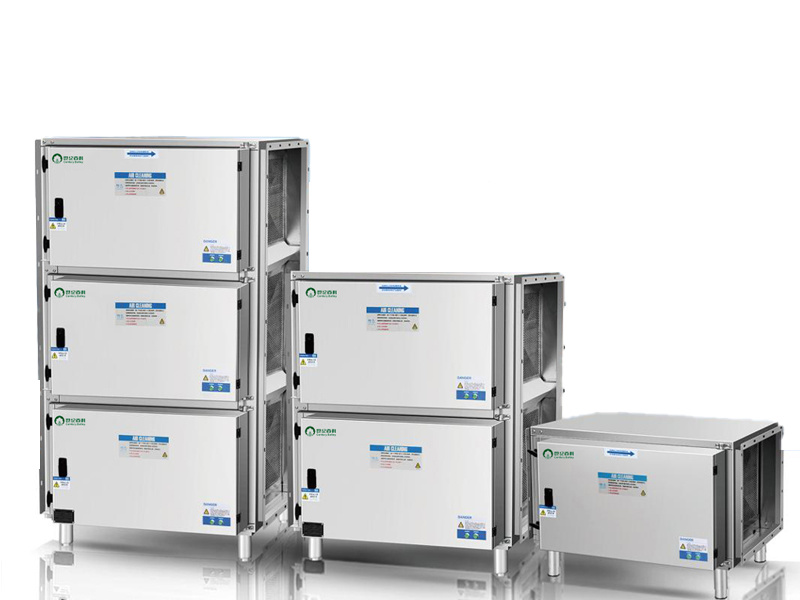
Shenzhen Century Bailey mainly engages in the independent research and development of large-scale catering industry oil fume purifiers , oil fume purifiers ,oil fume purification equipment, Century Bailey Oil fume purification integrated machine 。This company's self-developed new generation of wet oil fume purification integrated machines, UV photolysis oil fume purifiers, and dynamic physical interception oil fume purifiers meet the needs of different customers. Simplified traditional Oil smoke purification system, improved equipment reliability, and far exceeded national emission standards. Company website: www.szbailey.com
More news



Hotline:+86 136 849 29821
Email:13684929821@139.com
Address:No. 6, Junzibubujun Industrial Road, Guanlan, Longhua New District, Shenzhen


